

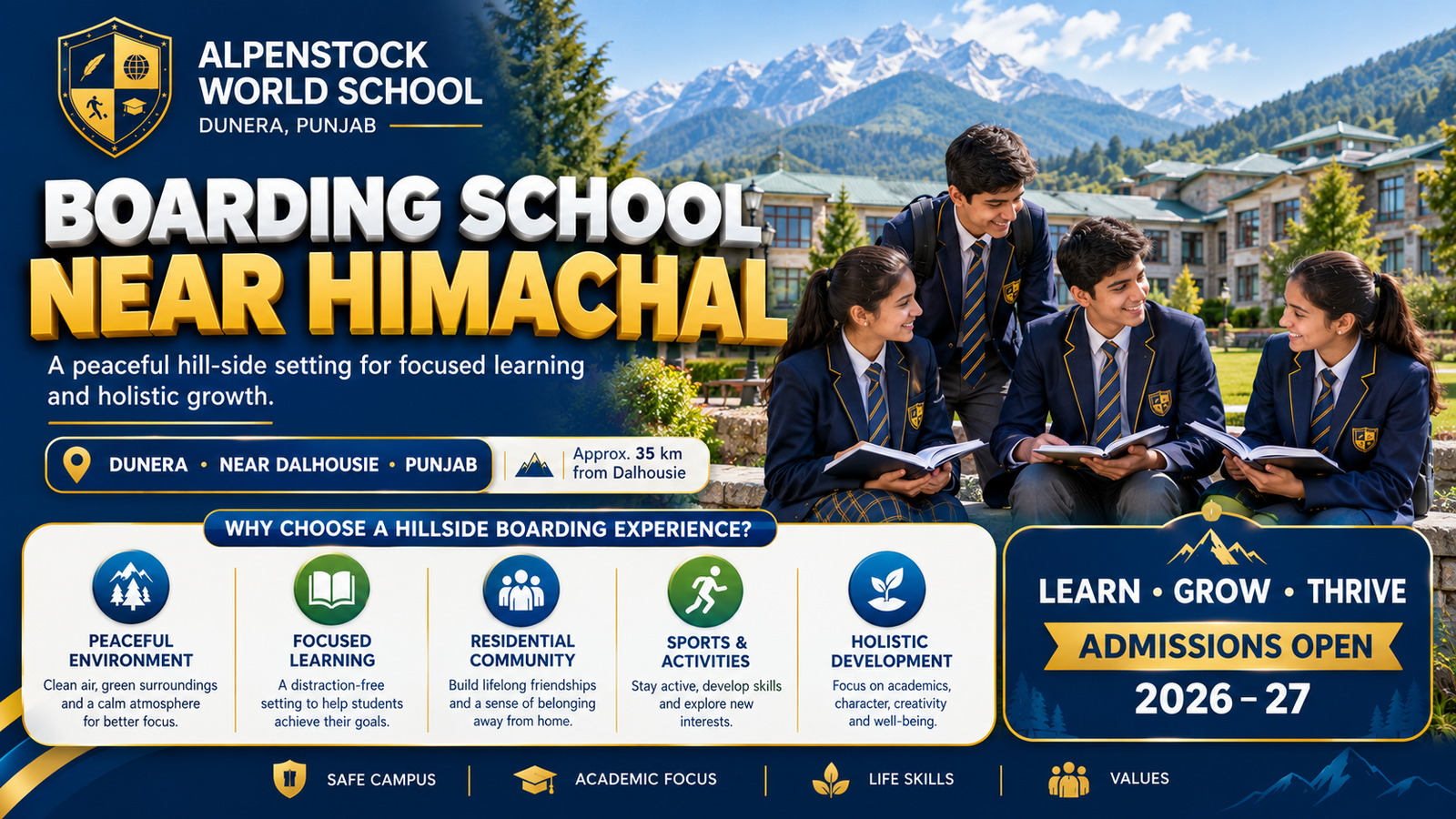
One of the most crucial choices parents make for their kids is which school to send them to. Families are thinking more and more about how their children learn, develop, gain self-assurance, and become independent outside of the classroom. This is one among the reasons parents looking for a well-rounded educational experience are drawn to boarding schools close to Himachal. The tranquil settings, close proximity to the foothills of the Himalayas, and fewer distractions can foster an environment where students are inspired to concentrate on their studies while taking in the scenery and a disciplined residential lifestyle.
Schools in Punjab and the foothills of the Himalayas provide a desirable blend of natural surroundings and accessibility for many families. While a boarding school in Pathankot might offer easy access to Punjab, Himachal Pradesh, Jammu, and other areas, a boarding school near Dalhousie can offer a tranquil location away from bustling urban environs. When combined, these places offer educational opportunities that integrate both intellectual and personal development.
Why the Location of a Boarding School Matters
A student’s everyday experience might be impacted by the location of their school. The surrounding environment can have an impact on focus, emotional health, physical exercise, and outdoor learning opportunities, even though academic facilities and curricula are still crucial. Students may have more room to study, play sports, explore the outdoors, and engage in meaningful peer interactions at schools located outside of densely populated urban areas.
Nowadays, parents frequently search for educational institutions that offer more than just textbooks. Students might have a regular schedule that includes classroom instruction, study sessions, leisure activities, sports, creative programs, meals, and supervised residential time on a well-designed residential campus. The combination can help pupils become more independent, responsible, and adept at managing their time.
Because it provides access to both modern educational facilities and picturesque foothill scenery, the Punjab-Himachal region is very appealing. Thus, academic quality, campus amenities, housing arrangements, safety, student support, extracurricular activities, and location are all factors that parents can take into account while choosing a school.
1. Peaceful Environment Supports Better Learning
The potential for a tranquil setting is one of the main reasons families think about sending their children to schools in more tranquil areas. In densely populated places, students may encounter a variety of distractions, such as traffic, excessive screen time, congested environments, and unstructured routines. A well-planned boarding campus can produce a more structured environment where students are aware of when to go to class, study, engage in extracurricular activities, unwind, and go to bed.
A tranquil campus does not imply that pupils are cut off from the outside world. Rather, it can create a setting where kids have more chances to participate in worthwhile activities and fewer needless distractions. Students can be active and involved all day long with the help of sports fields, libraries, labs, activity rooms, art programs, and outdoor areas.
This experience can be further enhanced by the neighboring foothills and the natural surroundings of Punjab’s northern districts. Open areas and green spaces may promote outdoor activities and provide kids a chance to escape the routines of the classroom. A healthier school experience may result from striking a balance between academic work and leisure.
How a Peaceful Campus Can Help Students
A well-run residential setting could benefit students in the following ways:
- Create regular study schedules.
- Prioritize your studies more.
- Engage in physical activities and sports
- Develop more effective time management techniques
- Savor outdoor and natural experiences
- Develop friendships in a controlled environment
- Develop greater self-reliance and responsibility
- Strike a better balance between your studies and leisure time.
Instead of making a decision based only on geography, parents should still consider the real campus setting of each institution. The daily routine, residential facilities, student support, and supervision quality are still crucial.
2. The Advantage of the Himalayan Foothills
The foothills of the Himalayas offer a unique geographic environment for learning. The area blends easily accessible towns and cities with mountain-influenced scenery. This can give kids the chance to encounter a setting that is distinct from crowded cities.
Outdoor activities, nature-based experiences, athletics, field trips, and experiential learning can all be included into student life at schools near the foothills. By promoting observation, cooperation, problem-solving, curiosity, and physical health, these activities can enhance classroom instruction.
Parents who want their kids to experience a residential setting surrounded by open spaces may also find the location appealing. Depending on the campus and its program, students may have the chance to engage in outdoor recreation and school activities rather than spending the majority of the day inside structures.
But parents need to understand the difference between being close to mountains and providing a quality educational experience. A beautiful setting is important, but it shouldn’t take the place of skilled instructors, a solid curriculum, suitable residential care, safety measures, academic support, and state-of-the-art facilities.
3. Distraction-Free Learning Can Improve Focus
More entertainment and knowledge are available to pupils nowadays than in the past. Maintaining a regular study schedule might be difficult due to smartphones, social media, online games, streaming services, and continual digital notifications. Students can establish more distinct boundaries between their academic obligations and leisure time at a residential school with suitable technology policies and monitored routines.
Distraction-free learning becomes crucial in this situation. Students can set aside specific times for lessons, assignments, revision, reading, sports, hobbies, and leisure with an organized school calendar. Instead of relying solely on parents to remind them of their academic obligations, adolescents can progressively gain time management skills when routines are regular.
Peer learning can also be promoted via boarding school. Living and studying among classmates gives students the chance to talk about classes, work together on projects, take part in group activities, and encourage one another. This setting can foster the growth of cooperation and communication skills under the right supervision.
Parents should seek out educational institutions that strike a balance between rigidity and adaptability. In addition to having clear objectives, students also need enough leisure time, relaxation, social connection, and chances to engage in extracurricular activities.
Why a Boarding School Near Himachal Appeals to Families
Families that wish to give their kids a residential education without putting them in a really remote area may find a boarding school close to Himachal appealing. The area provides a useful link between the mountainous regions of Himachal Pradesh and the plains of Punjab.
Accessibility can play a significant role for households in northern India. In addition to giving their children a residential environment that is distinct from daily city life, parents want to know that they can get to the school when needed.
Students’ enjoyment for outdoor experiences may also be fostered by the surrounding topography. Students can take part in athletics, outdoor activities, educational field trips, and other programs that promote learning outside of the classroom, depending on the facilities and policies of the school.
Why Parents Search for a Boarding School Near Dalhousie
For families looking for schools in and around the northern Punjab-Himachal region, the term “boarding school near Dalhousie” is becoming more and more important. Due to Dalhousie’s reputation for peaceful surroundings and beautiful scenery, parents who want their children to receive an education in a natural setting find the larger region appealing.
But being close to a well-liked hill location shouldn’t be the only consideration. The school’s curriculum, affiliation, faculty, housing arrangements, student-teacher ratio, safety precautions, healthcare support, sports facilities, dining options, technology resources, and communication methods should all be looked into by parents.
A school can maintain a robust academic framework while offering the advantages of a foothill location. Families that wish to give their children a residential education experience without compromising academic standards may find this combination especially helpful.
Why Pathankot Is an Important Educational Location
The strategic location of Pathankot links Punjab with Jammu and Himachal Pradesh. Families seeking residential schooling in northern India will find the area handy as a result.
A Pathankot boarding school might offer a helpful compromise between residential campus living and accessibility. The location may be useful for school visits, admissions, and family relations for parents from various parts of Punjab and surrounding areas.
Access to the region’s greater cultural and physical diversity is another benefit of the location. While still having access to a major transit corridor, students can gain exposure to many communities, landscapes, activities, and educational opportunities.
The best option for parents should mix educational quality and location. The curriculum, teaching standards, campus facilities, residential care, student safety, extracurricular activities, and personalized learning support should all be taken into account in addition to an accessible address.
Residential Life Builds Independence
Residential living is one of the distinguishing features of boarding school. Pupils learn how to handle everyday tasks like keeping their items organized, adhering to timetables, upholding personal routines, taking part in group activities, and showing consideration for common areas.
These encounters can progressively foster independence. Students discover that responsibility and preparation are necessary for a successful everyday existence. Additionally, kids learn how to get help from classmates, coaches, wardens, and teachers.
Social growth can also be strengthened by residential life. Students are exposed to a variety of personalities, viewpoints, hobbies, and communication styles while they live with their classmates. Students can acquire cooperation, empathy, conflict resolution, leadership, and teamwork with the right guidance.
As a result, parents should carefully consider the hostel amenities. A good residential experience includes things like clean accommodations, wholesome food, supervision, hygiene, security, recreational opportunities, and easily accessible pastoral support.
Academic Growth Beyond the Classroom
A good boarding school should see education as more than just classroom learning. Opportunities for students to apply ideas, pursue interests, and hone practical skills are essential.
Sports can foster discipline and teamwork, technology can improve research and digital literacy, libraries can promote independent reading, and labs may help scientific inquiry. Students can gain self-expression and confidence through creative and performing arts activities.
Because academic and extracurricular schedules can be structured within a single coordinated routine, a residential environment can facilitate the integration of these activities into daily life. After courses, students might have time to study under supervision before engaging in sports, clubs, the arts, or other activities.
When assessing a school, this all-encompassing method assists parents in looking beyond test scores. Academic success is important, but so are communication abilities, self-assurance, flexibility, leadership, physical health, inventiveness, and responsible decision-making.
What Parents Should Check Before Choosing a School
Parents should try to visit the campus and ask specific questions before choosing a boarding school. Although a picturesque setting might make a good first impression, the school’s entire instructional ecosystem merits careful consideration.
Parents ought to think about:
Curriculum and affiliation: Verify that the child’s future educational goals align with the academic program.
Instructional quality: Recognize academic support structures, faculty credentials, and instructional strategies.
Residential facilities: Examine dining areas, recreation areas, rooms, hygienic conditions, and supervision procedures.
Safety: Inquire about emergency protocols, student safety, healthcare access, and campus security.
Daily schedule: Recognize how the school manages meals, rest, sports, activities, lessons, and supervised study.
Student support: Find out how the school helps kids with their academic, social, and emotional needs.
Sports and activities: Seek out chances that promote leadership, teamwork, creativity, and physical fitness.
Parent communication: Recognize how parents are informed about residential life, activities, attendance, and academics.
Technology policies: Verify the effective use of digital technologies and the proper management of screen time.
Location and accessibility: Take into account how handy the school is for family visits, travel time, and connectivity.
A Balanced Choice for Modern Families
More and more parents are looking for learning environments that promote more than just academic achievement. They want schools where kids may grow in self-assurance, self-reliance, self-control, communication abilities, physical health, and a love of study.
Schools in Punjab and the foothills of the Himalayas can provide an intriguing blend of natural settings and academic structure. Students can participate in athletics, creative programs, outdoor activities, and residential community life in addition to having devoted study time on a well-run campus.
Instead of choosing a school only because it’s close to a beautiful location, it’s important to consider the whole experience. The ideal residential setting is one in where everyday routines, amenities, student support, safety, education, and location all function together.
Conclusion
Residential education is becoming more popular in Punjab and the Himalayan region, which is indicative of a wider change in parental expectations toward education. Families are searching for settings that can blend academic success with self-reliance, self-control, outdoor activities, and well-rounded student growth.
While the Himalayan foothills might offer chances for outdoor excursions and nature-based learning, a tranquil setting can aid improve concentration. Structured routines can also promote distraction-free learning and motivate students to assume more accountability for their academic objectives.
The decision should eventually center on the child’s full educational experience, regardless of whether families look at options in Punjab, Pathankot, or neighboring Himachal regions. The ideal boarding school in Pathankot should prepare kids for academic success, responsible maturity, and a changing world while offering a secure and encouraging home away from home.
The location’s beauty is not the most crucial factor for parents comparing residential schools. The question is whether the school can transform that setting into worthwhile learning opportunities while upholding strict academic, safety, student care, and personal growth requirements.
Recommended to read:
