


Your child studies five or six hours a day, and you still can’t tell if it’s enough. When you ask your children how the preparation is going, you get “fine.” When you ask what they finished this week and the answer gets vague.
This guide fixes that. You’ll get a clear way to prepare for board exams, a realistic board exam study schedule, and a revision method that works. It also covers the mistakes that quietly cost students marks. Nothing here is theory. It’s what consistently separates students who score well from students who just work hard.
What Is the Best Study Plan for Board Exams?
The most effective approach to preparing for a board examination is: learn, practise, revisit. Begin at least 5-6 months before, complete the syllabus at least 6-8 weeks before and allocate the last couple of weeks to revision and past papers rather than fresh material.
The common mistake most students make is to see the syllabus as a single assignment and continue to “study” until the week of the exam, and there’s not enough time to revise. Revision is not a “bonus. It’s where marks are created.
The Three-Phase Plan
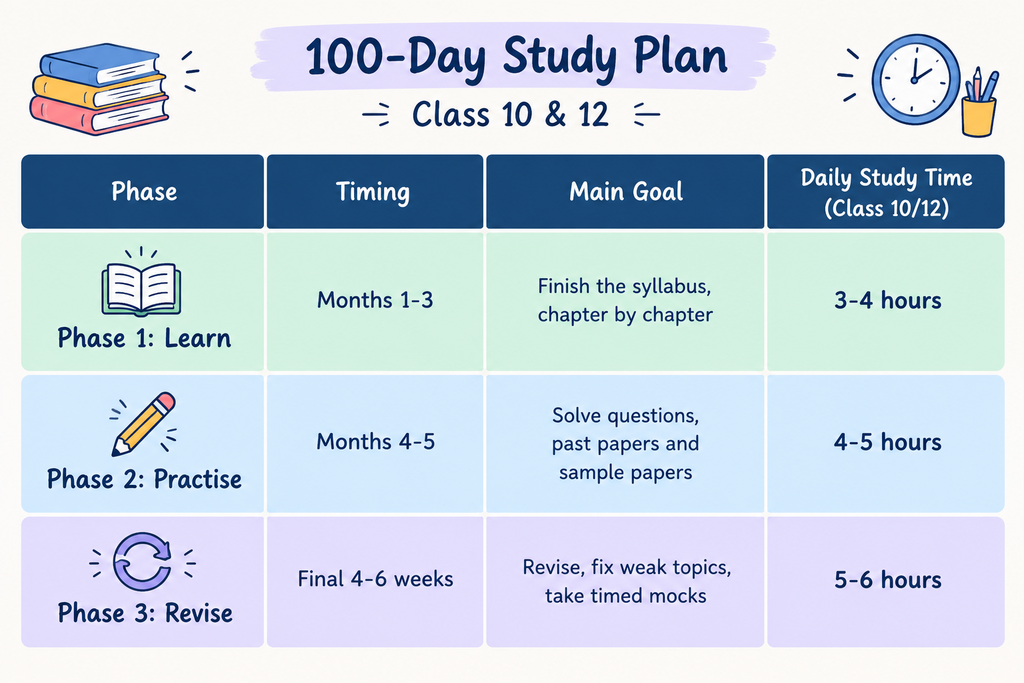
These are school-day numbers. On weekends and holidays, add an hour or two. Going beyond 7 hours a day doesn’t help. Focus drops, and the extra hours turn into staring at pages.
How to Build a Board Exam Study Schedule That Actually Works
The key to a good study schedule is not hours; it’s subjects! Try to use the most effort on your most difficult subject, vary subjects each day and have one rest day each week.
The construction process is as follows:
- For each of the subjects list the subject and rate it honestly. Indicate on each one whether it is strong, average or weak.
- Schedule the longest study time in the day for weak subjects. Mind is fresh, that’s when.
- Read 2-3 subjects per day. 1 subject per 8 hours is enough to exhaust the brain. This maintains its sharpness with switching.
- Learn in 45-50 minute sessions and 10 minute breaks in between. Take walks, drink water, stretch. Don’t pick up the phone.
- Continue weekly review on Sunday afternoon. Review the week’s learning.
Parents: Your role isn’t to sit next to the student! Your role is to safeguard the schedule. Avoid having visitors, running errands, and family issues during study blocks and set a dinner and sleep schedule.
Board Exam Preparation Tips That Make the Biggest Difference
Solving past papers, practise writing answers by hand and getting 7 hours sleep per night are the top tips for the most marks. All other considerations pale in comparison.
1. Begin with the text book; not the guide books.
Board questions are taken from the syllabus. Read your textbook correctly, and for practice add reference books. If a student has read the textbook, he will beat the student who has skimmed five guides.
2. Solve at least the previous 10 years of question papers.
This is the one thing a student can do most effectively. The pattern, weightage, common traps and the question style are given in the past papers. Complete last 3 papers within strict time limits, without notes or a phone.
3. Practice writing, not reading
Reading seems like getting ahead, but this is the poorest method of learning. Handwritten answers develop quickness, handwriting endurance and recall ability. If you are unable to write it from memory then you do not know it yet.
4. Understand how marks are awarded
Marks are awarded for steps, keywords, labelled diagrams and structure. Marks will not be awarded if an answer is correct but there is no working. Marking schemes and answers to be written as per the study.
5. Stop all-nighters
During sleep, memory becomes “locked in. If a student sleeps for 7 hours, he remembers more than a student who crams until 3 a.m. Do not take any late night cramming.
Revise Strategy: How to Score Well in Board Exams
For good marks in board exams, edit each topic 3 times: 1 day after learning, after 1 week and then 1 month before the exams.
The revision method that works is:
- Active recall: Shut the book, and write down as much as you can remember about the chapter. Next review what you missed.
- One page summaries: Summarize each chapter in one page of formulas, definitions, dates and diagrams. These will be your revision for last week.
- Have an error book: Make a note of all the errors made in practice tests and correct the answer. Check it out each weekend. Most students make the same 5 mistakes.
- Timed mocks: Mocks taken at the same day of the exam 4 – 3 days prior to the exam.
What is not effective: Highlighting entire pages, five or more rereadings, and viewing lectures at double speed without asking questions. These feel like work, and end up with subpar results.
What Parents Should Do (and Stop Doing)
Parents can have an impact on results that they are not aware of, and many times, it is a negative one.
Do this:
- Do not ask “How many hours did you study?” but rather “What did you cover today?”
- Offer healthy food, quiet time and regular bedtime.
- Be aware of impending burnout: headaches, irritability, and loss of appetite.
Stop doing this:
- Making comparisons with cousins and/or fellow children.
- Asking about marks every day.
- Increased late tuition in final 2 months. It cuts into revision, sleep.
An environment also makes a difference, too. For board-year students, a disciplined environment like an ICSE boarding school in Punjab is an attractive option as it offers predetermined study schedules and easy access to teachers with minimal distractions.
If you are looking at choices, the best residential school in Punjab for your kid is the one that combines academic rigor to appropriate pastoral care.
The Week Before the Exam
Don’t learn anything new. Complete your one-page summaries, error notebook and one light mock paper for the week. Follow the same sleeping pattern, carry your stationery and admit card on the night prior to the centre’s opening and arrive early. Students write more effectively when they are at peace.
Conclusion: The One Decision That Matters
It is not about the longer you study, the better you will do on the board exam. It comes from a plan: complete the syllabus early, work through past papers, revise in layers and sleep well. A good senior school in Punjab will start preparing students for the board exams from Class 11 onwards and not only in the last term of the course.
The task for you this week is to sit as a couple, write down the three stages and set a time frame for the real exam date, and agree on a daily schedule you can both follow. Then start tomorrow. Any good plan began today, is better than any perfect plan started next month.
